


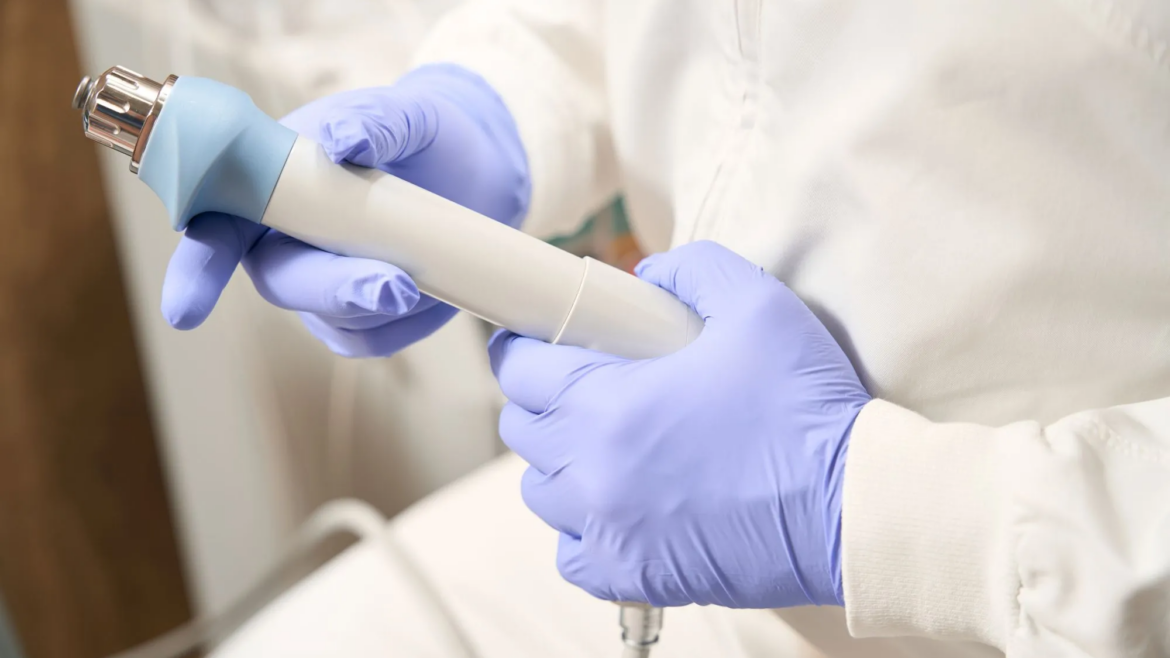
Shockwave therapy may help reduce penile pain associated with Peyronie’s disease, but it has not been shown to reliably straighten penile curvature or reduce the scar tissue responsible for the condition. Men with Peyronie’s disease may experience painful erections, changes in penile shape, or erectile dysfunction (ED), and these symptoms require different treatment considerations. At Men’s Health Medical Care, we help men in Miami explore their sexual health treatment options and understand when additional medical evaluation is necessary.
What Peyronie’s Disease Changes About Erections
Peyronie’s disease develops when fibrous scar tissue, known as plaque, forms within the tunica albuginea, the tissue surrounding the erectile chambers of the penis. Because the affected tissue does not stretch normally during an erection, the penis may bend toward the area of plaque.
The location and extent of the plaque determine how the condition affects penile shape and function. Some men develop a noticeable curve, while others experience narrowing, an indentation, an hourglass-shaped deformity, or a reduction in penile length. These structural changes may interfere with penetration even when erectile rigidity remains adequate.
Peyronie’s disease may also affect erectile function. Pain can interfere with sexual activity, while significant deformity may compromise stability during penetration. Some men experience erectile dysfunction due to associated vascular problems or other contributing conditions rather than the curvature itself.
The condition generally progresses through an active phase, when pain or penile deformity may change, followed by a stable phase, when the deformity stops progressing. Pain often improves over time, but established curvature is less likely to resolve without treatment. Identifying the disease phase helps determine which treatment options are appropriate.
Where Shockwave Therapy May Help With Peyronie’s Symptoms
Extracorporeal shockwave therapy (ESWT) may help reduce penile pain associated with Peyronie’s disease, particularly during the active phase when painful erections are a prominent symptom. Clinical studies have demonstrated pain reduction in some patients, although the degree of improvement varies.
Pain frequently improves as Peyronie’s disease enters its stable phase, even without shockwave treatment. For men with mild or manageable discomfort, observation and appropriate pain medication may be sufficient. Shockwave therapy may be considered when pain interferes with sexual activity or daily comfort, particularly when simpler management has not provided adequate relief.
However, the potential benefit must be weighed against the likelihood of natural pain resolution, treatment costs, and the uncertainty of additional improvement. The American Urological Association permits shockwave therapy for penile pain, while the European Association of Urology gives a weak recommendation for its use during the active phase.
Men with Peyronie’s disease may also experience erectile dysfunction associated with impaired penile blood flow. Low-intensity shockwave therapy has been investigated as a treatment for vascular erectile dysfunction, but evidence from studies involving men with ED generally does not establish that the same treatment will improve erections in men with Peyronie’s disease.
Men’s Health Medical Care offers GAINSWave therapy , a noninvasive acoustic wave treatment marketed for erectile dysfunction. However, GAINSWave protocols and the extracorporeal shockwave devices used in Peyronie’s disease clinical trials are not necessarily equivalent. Evidence supporting pain relief from one treatment method should not automatically be applied to another.
Patients with both Peyronie’s disease and erectile dysfunction require an assessment of their penile structure and erectile function before selecting acoustic wave treatment. The presence of curvature alone does not establish whether reduced blood flow contributes to erectile difficulties or whether an ED-focused treatment would be appropriate.
What Shockwave Therapy Cannot Reliably Correct
Shockwave therapy has not demonstrated consistent effectiveness in reducing penile curvature or plaque size in men with Peyronie’s disease. Clinical evidence does not establish that the treatment reliably breaks down fibrous plaque, restores normal penile shape, or reverses an established deformity.
The American Urological Association recommends against using extracorporeal shockwave therapy to reduce penile curvature or plaque size. The European Association of Urology also recommends against its use to improve penile curvature.
These limitations are particularly important for men experiencing significant penile narrowing, an hourglass deformity, or structural instability during an erection. Such changes may prevent satisfactory penetration even when erectile rigidity is otherwise adequate.
Shockwave therapy alone is not an established treatment for correcting these structural problems, regardless of how long a man has experienced Peyronie’s disease. The need for additional treatment depends on the type of deformity, its effect on sexual function, and the patient’s treatment goals rather than disease duration or curvature severity alone.
When Peyronie’s Disease Needs Medical Evaluation First
Men with suspected Peyronie’s disease should undergo a medical evaluation before starting shockwave therapy. Establishing the disease phase, identifying the extent of penile deformity, and assessing erectile function help determine which symptoms require treatment and whether shockwave therapy is appropriate.
An evaluation generally includes a medical and sexual history, a physical examination, and an assessment of penile curvature and erectile function. A clinician may request photographs of the erect penis or perform an examination using a medically induced erection when an objective assessment of the deformity is necessary.
Penile ultrasound may be used when additional information about plaque characteristics or penile blood flow would influence treatment selection. It is not required for every patient, and the need for further testing depends on the clinical findings and the treatment being considered.
New Pain, Worsening Curvature, or Penetration Difficulty
New penile pain, a developing lump, or a noticeable change in curvature warrants medical assessment. These symptoms may indicate active Peyronie’s disease, during which the eventual extent of penile deformity remains uncertain.
A man experiencing progressively worsening curvature should not rely on shockwave therapy for pain relief while delaying evaluation. Reducing discomfort does not establish that the condition has stabilized or that further structural changes will not occur.
Difficulty with penetration also requires assessment because the degree of curvature does not fully determine how severely Peyronie’s disease affects sexual function. The direction of the bend, associated narrowing, and stability of the erect penis influence whether intercourse remains possible and which treatments may be appropriate.
Sudden severe penile pain accompanied by a popping sensation, rapid swelling, or bruising following an injury during sexual activity requires immediate medical attention. These symptoms may indicate a penile fracture or another acute injury rather than the gradual development of Peyronie’s disease.
ED Symptoms Alongside Peyronie’s Disease
Men who experience erectile dysfunction alongside Peyronie’s disease need an assessment that distinguishes problems with erectile rigidity from structural limitations.
A man who achieves a firm erection but cannot penetrate comfortably because of curvature has a different treatment need from someone who cannot maintain sufficient rigidity. Some patients experience both problems, requiring treatment that addresses each contributing factor.
Reduced penile blood flow cannot be established from erectile symptoms alone. Medical history, examination findings, and the response to previous ED treatments help guide the assessment. Penile Doppler ultrasound may be appropriate when identifying a vascular problem that would change treatment selection, particularly before certain surgical procedures.
At Men’s Health Medical Care, we offer erectile dysfunction treatment services for men experiencing difficulty achieving or maintaining erections. Patients with Peyronie’s disease require additional consideration because improving erectile rigidity alone may not restore satisfactory sexual function when significant penile deformity remains.
Shockwave Therapy vs Other Peyronie’s Treatment Paths
Peyronie’s disease treatment depends on the symptoms requiring intervention, whether the condition is active or stable, and the effect of penile deformity on sexual function. Different treatment approaches address pain, curvature, or erectile dysfunction, and the appropriate choice depends on the patient’s clinical findings.
| Treatment approach | Primary purpose | When it may be considered |
| Shockwave therapy | Reduce penile pain | Selected patients with painful Peyronie’s disease, particularly during the active phase. It is not recommended for correcting curvature or reducing plaque size. |
| Observation and pain management | Monitor disease progression and manage discomfort | Men with mild symptoms or active disease that does not currently require treatment directed at the deformity. Appropriate pain medication may be recommended when necessary. |
| Penile traction therapy | Reduce curvature or preserve penile length through controlled mechanical stretching | Selected patients seeking a nonsurgical approach to penile deformity. Results vary, and treatment requires consistent use of an appropriate device. |
| Collagenase injections | Reduce curvature by breaking down collagen within penile plaque | Selected patients with stable disease, suitable plaque characteristics, and curvature within the treatment’s approved criteria. Under the established US treatment indication, eligible patients have a palpable plaque and curvature of at least 30 degrees. Treatment carries risks including bruising, swelling, and potentially serious penile injury, including corporal rupture. |
| Surgical correction | Correct penile deformity that interferes with sexual intercourse | Men with stable disease and functionally significant deformity. The procedure depends on penile anatomy, erectile rigidity, and treatment goals. Potential risks include penile shortening, altered sensation, and changes in erectile function. |
| ED medication or penile prosthesis | Improve erectile rigidity when Peyronie’s disease occurs alongside erectile dysfunction | Oral medication may be appropriate when erectile function responds adequately. A penile prosthesis may be considered when ED does not respond sufficiently to less invasive treatments and may also permit correction of associated deformity. |
Men with substantial curvature but adequate erectile rigidity may be candidates for traction therapy, injection treatment, or surgical correction, depending on their individual circumstances. Injection treatment is not suitable for every plaque location or deformity, and patients with complex curvature or significant penile narrowing may require a different approach.
When erectile dysfunction is also present, treatment selection must account for whether improving rigidity will provide sufficient function or whether the penile deformity requires separate intervention. A urologist can determine which approach is appropriate based on the disease phase, penile anatomy, erectile function, and the patient’s treatment goals.
Peyronie’s and ED Care at a Men’s Health Center in Miami
Men experiencing penile curvature, painful erections, or erectile difficulties should establish the cause of their symptoms before selecting a treatment. Peyronie’s disease may affect penile structure and erectile function simultaneously, but the treatment required depends on which symptoms interfere with sexual activity.
At Men’s Health Medical Care , we provide men’s sexual health services in Miami Lakes, including GAINSWave therapy for erectile dysfunction. Men experiencing changes in erectile rigidity may contact our clinic to discuss available services and whether further medical assessment is necessary before considering treatment.
Patients with suspected Peyronie’s disease should establish whether their primary concern is penile pain, structural deformity, erectile dysfunction, or a combination of these symptoms. Men with progressive curvature, significant narrowing, or difficulty with penetration may require evaluation by a urologist to determine whether treatment directed at the penile deformity is necessary.